

You have no items in your shopping cart.


Tails
Making pet parenting easy
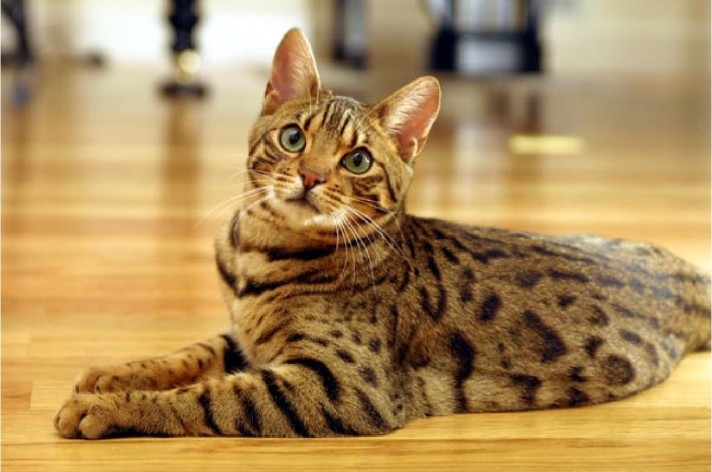
Bengal
This entry was posted on 2014-08-06.
Personality and Temperament
The Bengals bloodline consists of feral cats and because of this people tend to think that it’s a difficult breed choice. This isn’t true, breeders claim that it is loving and can be domesticated with ease, but isn’t a good lap cat. Nevertheless, it’s fond of human companionship, and is often around its family. As it has an active nature it thoroughly enjoys playing with children, particularly games.
Retaining it’s hunting instant which was passed down by its ancestors, makes it fond of hunting land animals and even those that are water dwelling. Its ancestor the Asian Leopard cat mastered the ability to catch fish in the wilderness, which can also be seen in the Bengal today. In a far more playful structure, your Bengal will enjoy swimming with you, playing about in the sink or even willing to take a bath or shower with you.
As the Bengal has a substantial amount of energy you will need to provide it with a great deal of playtime. Some thing to be aware of is the fact that most cats with lots of energy tend to like jumping up into high areas. It would be a good idea to try and keep all of your valuable breakables off your open shelves, especially the highest ones.
Traits
• Other names: Leopard cat
• Weight: Male: 3 - 6 kg; Female: 2 - 5.5 kg
• Height: Male: 90 - 110 cm; Female: 80 - 90 cm
• Coat: thick, luxuriant, soft
• Colour: Black, orange, silver, brown
• Litter size: 4-6 kittens
• Life span: 9-15 years
Physical Characteristics
It’s incredible coat that is thick, luxuriant and astonishingly soft is what makes the Bengal unique among cats. The spots on the coat that are like that of a leopard can be randomly placed, marbled pattern or horizontal with rosettes creating half circles. The colours of the coat come in brown or black marbled, brown or black spotted, but breeders have also created a snow marble and snow spotted white. There should be a sharp contrast between the spots and the background colour.
Glittering is a trait that the Bengal often possesses. Making its coat almost look like its been dusted with either pearl or gold. Naturally enhancing the attractiveness of the Bengal, this trait is loved among many. Furthermore its not sought after in the show ring and isn’t given singular preference.
The Bengal is a medium to large-sized breed, long, athletic build, broad snout and head, noticeable whisker pads and elevated cheekbones. The eyes that are broad and circular have dark markings around them. The ears are little and spherical at the points. The Bengal is graceful and able to move quietly with furtiveness. Its wildcat appearance is emphasized by its somewhat longer back legs, which make its back sit slightly higher then its shoulders. One of its most defining characteristics is its muscular build.
History and Background
Pairing the domestic cat with the wild cat has only successfully created the Bengal. There is some evidence stating that an attempt prior to the 1960’s to pair the Asian leopard cat with the domestic cat was made, but rather in the 1970’s did the Bengals real history begin. An amateur Californian breeder named Jean Sudgen possessed a body of cats, which were breed to be used in genetic experiments. Dr. Willard Centerwall part of Loyola University was doing tests on Asian Leopards, as they have partial resistance to cat leukemia. In the hope of developing an immunization he started to cross breed the Asian Leopards with the domestic cats.
When the program had ended, Dr. Centerwall found homes for the cats. Ms. Sudgen wanting to breed Asian leopard hybrids took some of the cats that showed sighs of a domestic disposition and those who had the incredible spotted patterns. In the 1940s, Ms. Sudgen while at UC Davis studying genetics started experimenting with feline hybridization. Dr. Centerwall gave her the opportunity to work with his Asian leopards and their hybrids. The cat fancy population unlike Dr. Centerwall wasn’t very supportive of Ms. Sudgen experiments. Many were apposed to breeding a domestic cat, with a wild cat. Even today the Cat Fanciers Association will not register the Bengal because of its bloodline. Since the 1980’s other alliances including The International Cat Association have welcomed this breed with open arms.
Remarried Ms. Sudgen took the name Mill, while crossbreeding she was warned that the offspring would be infertile, which was the case with the males. She had much more success with the female hybrids. Now that she was only left with female Asian leopard hybrids she needed to find a male to cross with. In exploring the possible breeds she could use, nothing seemed to be genetically sturdy enough. In 1982 her search finally came to an end, when a manager from the Indian New Delhi Zoo, showed her a leopard like street cat who had made its home in the rhinoceros enclosure at the zoo. Besides being feral, it was the perfect mate. After a few years Ms. Mills breeding program was operating full steam ahead.
With years of hard work and patience the Bengal breed exceeded their expectations in tenderness, affability and refinement. There are still some people, who don’t agree with the breed, but it has won many show awards and numerous people are very fond of the cat.
Nutrition
Click here to see what cat food we sell now.

